In the far north of the Kruger National Park, where the Luvuvhu and Limpopo Rivers carve through floodplains and fever tree forests, something remarkable happens every year: birds arrive.
Not from the next valley or the neighbouring reserve; from Europe, from Central Asia, from the Russian steppes with thousands of kilometres of open sky, ocean, desert and mountain range behind them. And they land here, in the Makuleke Private Concession, as if they have always known the way.
This is the story World Migratory Bird Day asks us to pay attention to. And if you have ever sat on the deck at The Outpost or Pel’s Post and watched the sky shift with wings at dusk, you already know why it matters.
Why Pafuri is different
The northern Kruger is not like the rest of the park. It sits at the meeting point of tropical and subtropical zones, where the vegetation shifts, the rivers widen and the birdlife becomes something else entirely. Birding author Callan Cohen has described Pafuri as “arguably the most exciting birding in Kruger,” and the numbers back that up: over 350 species have been recorded in the Makuleke Private Concession alone. Many of those species reach their southernmost limit here and are found nowhere else in South Africa.
What makes this area so magnetic for migratory birds is the convergence of habitats – riverine forest, sandveld, floodplains, mopane woodland and ancient baobabs. Each creates a micro-world with its own food sources, shelter and nesting opportunities and each draws a different cast of birds depending on the season.
The travellers that make the journey
Not every bird in Pafuri has flown halfway across the planet. Some are intra-African migrants, moving between countries on the continent as the rains dictate. Others are Palaearctic migrants, arriving from breeding grounds in Northern Europe and Central Asia to spend the southern summer in this rich, warm corner of the world. Here are some of the species that make the journey and a few resident icons that make Pafuri the birding destination it is.
The migrants
The Makuleke concession also draws some of Kruger’s most significant long-haul migrants during summer. Lesser Spotted Eagles arrive from Eastern Europe in their hundreds, filling the skies above the floodplains. Amur Falcons pass through on a journey of roughly 22,000 kilometres from Siberia. And the Thrush Nightingale, one of the rarest Palaearctic visitors to South Africa, is heard far more often than it is seen in the dense undergrowth along the Luvuvhu.
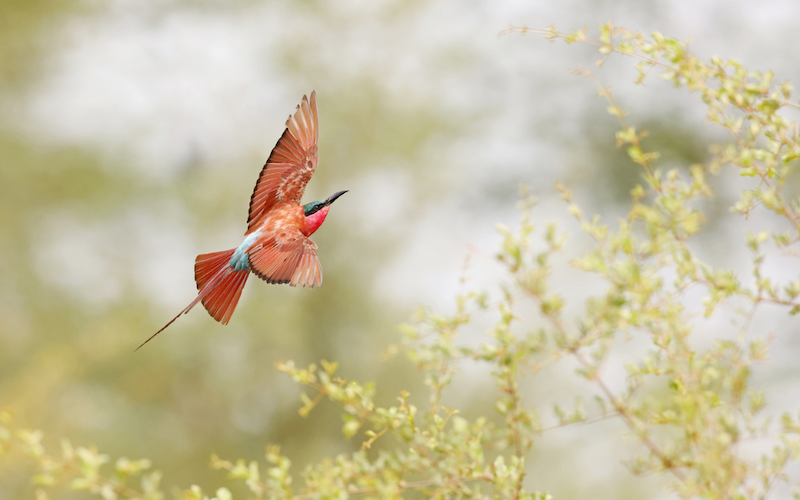
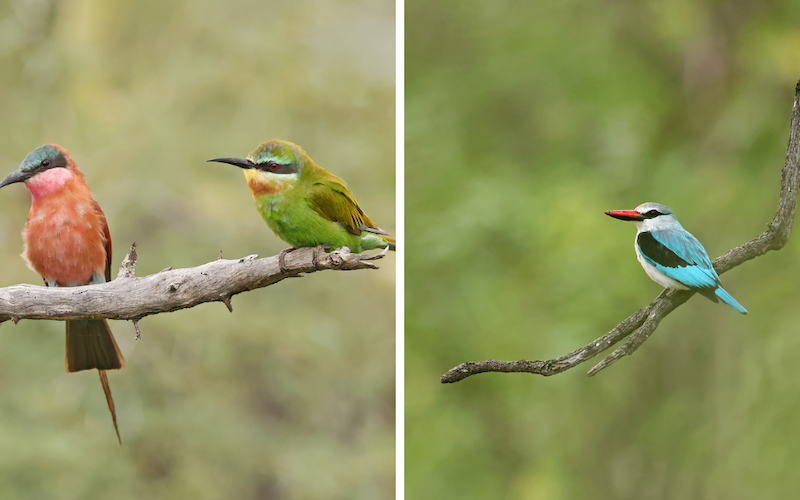
Carmine and Blue-cheeked Bee-eaters
Two of the most visually striking migrants in the northern Kruger and both present in the Makuleke concession during summer. The Southern Carmine Bee-eater is an intra-African migrant that breeds in colonies along riverbanks, arriving from further north on the continent to nest in the sandy cliffs of the Luvuvhu. The Blue-cheeked Bee-eater travels even further, migrating from breeding grounds in western Asia and the Middle East. Both species catch insects on the wing with extraordinary precision. Photographed side by side on the same branch, they are a reminder that Pafuri sits at the crossroads of multiple flyways.
Woodland Kingfisher
A well-known intra-African migrant whose arrival call is considered the unofficial announcement of summer in the northern Kruger. When you hear that distinctive descending trill from the riverine trees, the season has turned.
The residents
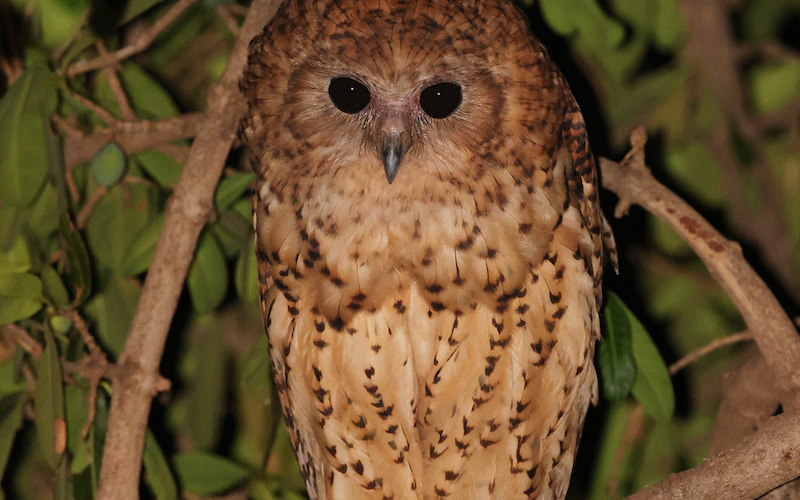
Pel’s Fishing Owl
The ghost of the Luvuvhu. One of the “Big Six” birds of the Kruger and among the most sought-after species in southern Africa. Pel’s Fishing Owl does not migrate. It holds territory along the river year-round, hunting fish from low-hanging branches at dusk. Up to eight pairs have been recorded along an 18-kilometre stretch of the Luvuvhu in the Makuleke Private Concession, and guests at The Outpost and Pel’s Post have heard its deep, resonant two-note call drifting across the water on still evenings. The lodge Pel’s Post is named in its honour.
They share the canopy and undergrowth with some of Pafuri’s most elusive residents. The Narina Trogon, iridescent green and scarlet-bellied, sits motionless in the riverine forest until its low, throaty call gives it away. The Tropical Boubou, a South African rarity with an estimated Kruger population of over 10,000 birds concentrated almost entirely in the far north, fills the Luvuvhu drives with its complex mix of rattles, whistles and snarling calls.
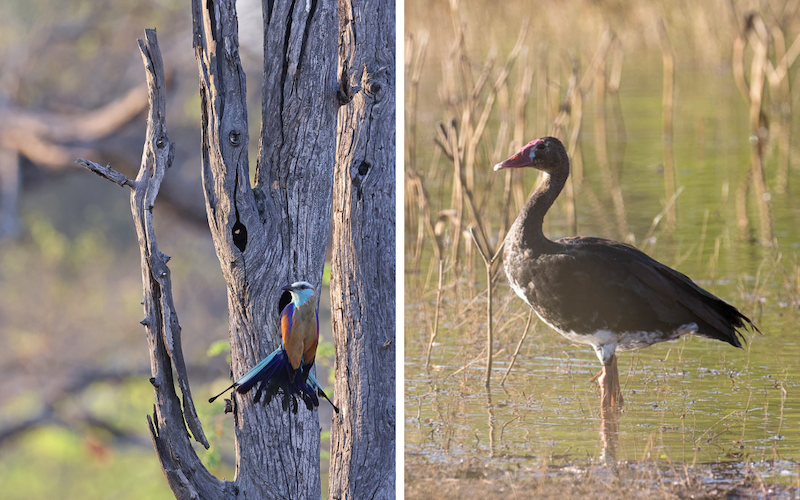
Racket-tailed Roller
Another Pafuri speciality that is rare elsewhere in South Africa but common north of the Limpopo. Found in mopane woodland, this striking bird is one of the species that draws dedicated birders to the far north.
Abdim’s Stork
A small, iridescent stork with a white belly and red legs that migrates seasonally across sub-Saharan Africa, forming large flocks near wetlands and grasslands. One of the seven official ambassador species for World Migratory Bird Day 2026, Abdim’s Stork is a reminder that not all migration stories involve crossing oceans. Some of the most important journeys happen within the continent, following the rains from one floodplain to the next. The Southern African Bird Atlas Project tracks its distribution across the region, and every sighting logged helps fill gaps in data that are still surprisingly thin for such a widespread bird.
Every bird counts
The theme for World Migratory Bird Day 2026 is “Every Bird Counts: Your Observations Matter.” It is a celebration of community science: the idea that ordinary people recording what they see can build the data that protects these species for the future. This year also marks the 60th anniversary of the International Waterbird Census, a global monitoring effort that has been tracking migratory waterbird populations since 1966. Six decades of volunteers counting birds at wetlands across the world. That is the kind of sustained, quiet work that makes conservation possible.
Platforms like eBird and BirdLasser allow anyone with a pair of binoculars and a phone to contribute to global migration tracking. Community science does not require a degree or special equipment. Every recorded sighting adds to a picture of population trends, migration timing and habitat use that researchers rely on to inform conservation strategies across continents.
The Makuleke Wetlands are also a designated Ramsar site, a Wetland of International Importance under the intergovernmental Ramsar Convention. Covering nearly 8,000 hectares of floodplain along the Luvuvhu and Limpopo Rivers, it was the first community-owned Ramsar site in the world, which is pretty remarkable! The birds that arrive here land in one of the most formally protected wetland habitats on the continent.
The birds continue to arrive
The Outpost and Pel’s Post are currently closed for rebuilding following flood damage to the Luvuvhu River area. The landscape is already regenerating, as it has done for millennia after the river rises. And the birds continue to arrive.
When we reopen, the birding will be as extraordinary as ever. The Pel’s Fishing Owl will still be calling from the ana trees at dusk. The Lesser Spotted Eagles will still fill the summer sky. And the Narina Trogon will still be sitting perfectly still in the canopy, daring you to find it.
In the meantime, the bush carries on. Because here, slow travel is the best way to travel.
Further reading
A Birding Big Year — The Widdows family’s search for South Africa’s rarest birds
Where the Wilderness Speaks — On slow safari, Sound Safari, and Pafuri birding
Become a Birder in Three Easy Steps — Our beginner’s guide to birdwatching on safari
When the River Rises — An honest update on our temporary closure
Go Slow — Why slow safari is at the heart of what we do
World Migratory Bird Day 2026 — This year’s theme: Every Bird Counts
BirdLife SA — Pafuri — Detailed birding guide to the region
SANParks Kruger Birds — Official Kruger birding information